
06 Jun Top 8 Tips for Lighting Different Studio Environments
TOP 8 TIPS FOR LIGHTING DIFFERENT STUDIO ENVIRONMENTS
How to Make Every Set Look Its Best on Camera
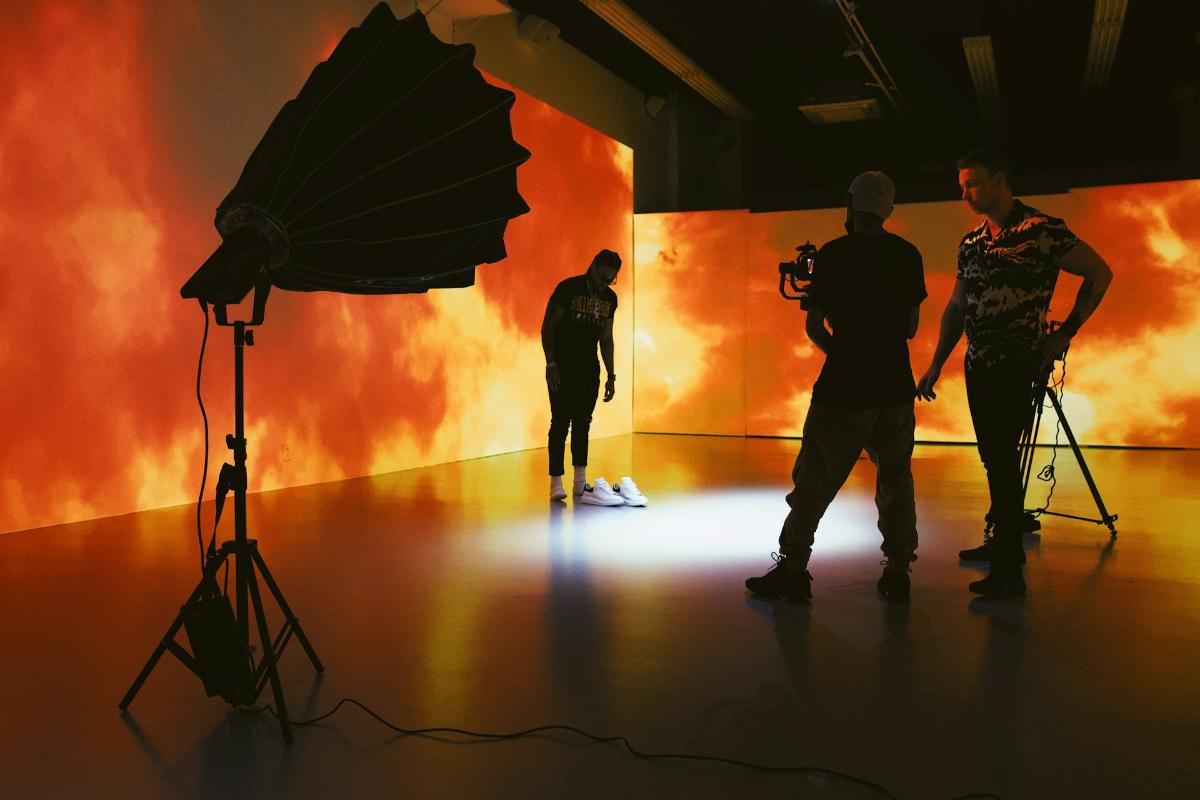
Lighting Is Storytelling
Every cinematographer knows that lighting is not just about exposure. It is about mood, character, and narrative. The way you light a scene tells the audience how to feel before a single word is spoken. A warm living room glow says comfort and safety. A harsh interrogation light says danger and tension. A flat hospital wash says clinical detachment.
The challenge is that different environments demand different lighting approaches. What works in a cozy living room will look ridiculous in an industrial alleyway. What works in a sterile office will kill the mood in a romantic cafe. At Warehouse 1 Productions, we have designed each of our sets with specific lighting possibilities in mind. Here are eight tips for getting the most out of each environment.
LIGHTING BY ENVIRONMENT
1. Alleyway: Hard Shadows and Motivated Sources
Our Alleyway set is designed to look like a gritty urban exterior at night. The key to selling this look is hard light with strong shadows. Use a single large source positioned high and to one side to mimic a streetlight. Let the shadows fall long and sharp across the brick walls. Add a cool blue rim light from behind to suggest moonlight or distant neon.
The brick texture in our Alleyway catches light beautifully. Side lighting brings out the mortar lines and creates visual interest that flat front lighting would kill. Use a haze machine to add atmosphere. The light beams cutting through haze will give your shots the cinematic quality of a big budget thriller. Keep your color temperature cool, around 5600K to 6500K, to sell the nighttime feel.
2. Living Room: Soft Key and Practical Motivation
The Living Room is where warmth lives. Your key light should be soft and diffused, positioned to mimic a practical lamp or window source. Our set has working lamps on side tables and a window area that can be motivated with a softbox from outside the frame. Use the practicals. Turn them on. Let them motivate your key and add fill to the shadows.
Color temperature matters here. Warm tungsten tones around 2700K to 3200K create intimacy. If you want a morning feel, push slightly cooler around 4000K and add a soft edge to your window motivation. The layered textures in our Living Room, from the rug to the curtains, absorb and reflect light in ways that create natural falloff. Do not overlight. Let the shadows breathe.
3. Office: Even Coverage with Fluorescent Feel
Offices are lit for work, not drama. The lighting should be even, functional, and slightly sterile. Our Office set has overhead fluorescent fixtures that you can use as practical motivation. Turn them on and let them provide your base exposure. Then add subtle keys and fills to shape faces without destroying the fluorescent feel.
The trick is not to make it too beautiful. Real offices have flat, unflattering light. If you are shooting a corporate scene, embrace that. If you are shooting an after-hours scene where two characters have a private conversation, turn off the overheads and use desk lamps for a warmer, more intimate mood. The same set, two completely different lighting approaches.
4. Interrogation Room: Single Source Drama
This is the set where lighting does the heavy lifting. Our Interrogation Room is built with an overhead fixture that creates harsh, direct light. Use it. A single hard source from above creates deep eye sockets and strong shadows under the chin. It makes everyone look guilty, which is exactly what you want.
For variation, add a secondary source from the side at a lower intensity. This creates a triangle of light on the shadow side of the face, classic Rembrandt lighting that adds dimension without softening the harshness. If you need a good cop scene, bring in a soft fill from the observation window direction. The contrast between the overhead harshness and the soft fill tells the audience that the dynamic has shifted.
5. Cafe/Bar: Warm Tones and Practical Magic
Bars and cafes live on atmosphere. The lighting should be warm, low, and motivated by practical sources. Our Cafe/Bar set has back bar lighting, pendant lights over the counter, and ambient wall fixtures. All of them work. Use them as your primary sources and add minimal key light to shape faces.
The bottles behind the bar are your secret weapon. They catch and refract light in ways that create beautiful background bokeh. Position your actors so the back bar is visible in the frame. Use a shallow depth of field and let those light points become part of your composition. Color temperature should be warm, around 2700K to 3000K. This is not a place for daylight balance.
6. Kitchen: Overhead Plus Fill for Function
Kitchens are workspaces. The lighting should be bright enough to see what you are doing, but not so flat that it looks like a cooking show. Our Kitchen set has overhead fixtures that provide good general coverage. Use them as your base, then add a soft key from the window direction to shape faces.
The reflective surfaces in a kitchen are both a challenge and an opportunity. Stainless steel appliances and tile backsplashes bounce light around. Use that bounce as natural fill. Position your key so it reflects softly off the counters and adds ambient illumination. Be careful with hot spots. A specular highlight on a refrigerator can blow out and distract from your actors.
7. Hospital Room: Flat, Clinical, and Controlled
Hospital lighting is designed for doctors, not cinematographers. It is flat, bright, and color-corrected to render skin tones accurately. Our Hospital Room set has overhead medical fixtures that create this exact look. Use them for your base exposure and resist the urge to make it beautiful.
The emotional power of hospital scenes comes from the contrast between the sterile environment and the human drama. Flat lighting makes actors look vulnerable. It removes the shadows that normally hide imperfections. Every wrinkle and worry line is visible. That is the point. If you want to shift the mood, add a practical bedside lamp for a warm glow that suggests comfort in an uncomfortable place.
8. Locker Room: Overhead Fluorescents and Grittiness
Locker rooms are utilitarian spaces. The lighting should feel institutional and slightly oppressive. Our Locker Room set has overhead fluorescent fixtures that create the flat, green-tinted look of real locker rooms. Use them as your primary source and add minimal shaping.
The metal lockers in our set reflect light in interesting ways. Position your actors so the locker doors create background texture and subtle light patterns. For a sports drama, this is perfect. For a more stylized approach, add a hard backlight that cuts through the fluorescent haze and creates separation. The contrast between the flat overhead and the dramatic rim can turn a mundane space into something visually striking.
WAREHOUSE 1 PRODUCTIONS NOTE
“We had a cinematographer shoot a proof of concept in our Interrogation Room and our Living Room on the same day. He used completely different lighting packages for each set. The Interrogation Room was one hard source and a bounce. The Living Room was a three-light soft setup with practical motivation. Both looked like they came from different productions, which was exactly his goal. The versatility of studio lighting is limited only by your imagination.”
Frequently Asked Questions
Do your sets have built-in lighting?
Yes. Every set has practical fixtures that work and are positioned for camera-friendly motivation. We also have lighting grids and power distribution to support your own equipment. You can use our lights, yours, or a combination.
Can I black out the sets for total light control?
Yes. All sets can be fully blacked out. You have complete control over every light source in the space. This is one of the biggest advantages of studio shooting over location work.
What color temperature are your practical lights?
Our practicals are a mix of tungsten and daylight balanced sources depending on the set. We can provide a detailed lighting spec sheet for any set before your booking so your gaffer can plan accordingly.
Is there enough power for large lighting packages?
Yes. Our facility has industrial power distribution designed for film production. You can run multiple large sources without tripping breakers. Just let us know your power requirements in advance.
Can I use gels and modifiers on your practical fixtures?
Yes, within reason. Our fixtures are designed to accept standard gels and diffusion. Just be careful with heat. We can advise on safe modification practices during your scout or pre-production call.
Key Takeaways
✓ LIGHTING BY SET
- Alleyway: Hard shadows, cool tones, motivated streetlight
- Living Room: Soft key, warm practicals, natural falloff
- Office: Even coverage, fluorescent base, subtle shaping
- Interrogation: Single hard source, dramatic shadows
- Cafe/Bar: Warm tones, practical motivation, shallow depth
- Kitchen: Overhead base, reflective bounce, functional brightness
- Hospital: Flat clinical, bright and sterile, vulnerable faces
- Locker Room: Fluorescent institutional, metal reflections
✓ UNIVERSAL PRINCIPLES
- Motivate every light source
- Use practicals as anchors
- Match color temperature to mood
- Let texture guide your angles
- Control is the studio advantage
LIGHTING CONTROL THAT LOCATION SHOOTING CANNOT MATCH.
Book a studio where every set is designed for cinematic lighting.
Eight standing sets | Full light control | Industrial power
About Warehouse 1 Productions: We operate standing film sets and studio spaces in Los Angeles for productions of all sizes. Our sets include the Alleyway, Interrogation Room, Living Room, Office, Cafe/Bar, Kitchen, Hospital Room, and Locker Room. We serve indie filmmakers, commercials, music videos, live streams, TV shows, and feature films. Call 818-940-1574 for availability.
Disclaimer: This article is for informational purposes only. Studio features, pricing, and availability are subject to change. Contact Warehouse 1 Productions directly for current rates and booking details.
Sorry, the comment form is closed at this time.